Car Wash Opening and Closing Checklist by Format




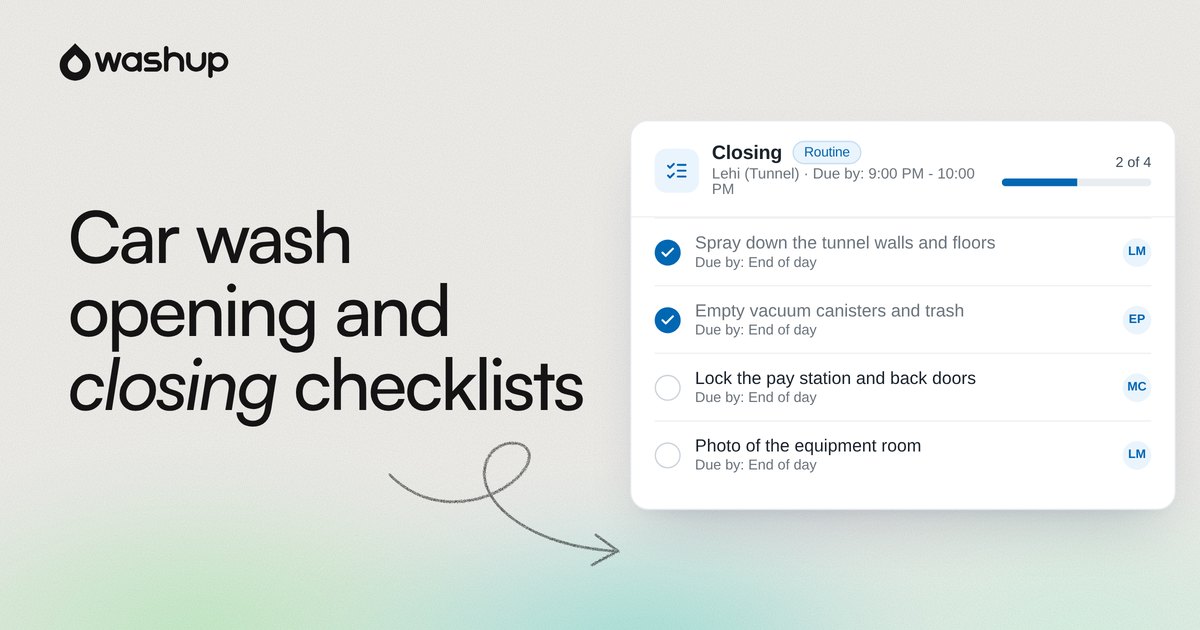
A car wash opening and closing checklist is two short lists your crew works every day. Opening proves the wash is ready before the first car: a ghost wash and a test car, chemicals, pay station, vacuums, safety stops. Closing leaves it ready for tomorrow: equipment cleaned and shut down, issues logged, site locked.
The lists change by format. A tunnel opens with a crew. An in-bay automatic or self-serve site may open with one person on a route, or nobody at all. Below are the actual items for each, plus our free basic opening checklist and basic closing checklist to start from.
Key takeaways
- Run a ghost wash at least 30 minutes before the wash opens, then a test car, so there’s time to fix what it turns up (Professional Carwashing & Detailing).
- 48% of consumers say broken or confusing payment, app or entry tech makes them less likely to return, so the pay station belongs on every opening list (ICA CAR WASH Pulse, Q3 2026).
- Operators expect 53% of unhappy customers to come back for a rewash. Only 17% say they do (ICA CAR WASH Pulse, Q2 2026). Missed opening checks rarely get a second chance.
- Self-serve brushes should be checked daily for grease, mud and damage, and replaced when the material is under 2 inches (iWash Technology via Professional Carwashing & Detailing, 2020).
What should be on a car wash opening checklist?
A car wash opening checklist should cover a ghost wash and test car, chemical levels and foam coverage, pump pressure, brushes or wraps, dryers, the pay station, vacuums, photo eyes and e-stops, lights, trash and drains, then a staffing check. Put a name and a finish time on it, before the first car.
That’s the core for every format. A ghost wash is a full wash cycle with no car in the bay. It shows you spray patterns, arches and timing before a customer’s car is in there. The test car shows you the result: is it clean, is it dry.
Order matters. Power and water first, then the ghost wash, then the walk while the system runs, then the test car, then the pay station and the lot. Anything that fails gets fixed or flagged before you open the gate, not after the first complaint.
Express tunnel opening checklist
An express tunnel moves cars on a conveyor through a line of equipment, usually with a crew on site from open to close. The opening list is the longest of the three.
- Power up the tunnel, hydraulic power unit, air compressor and RO (spot-free) unit. Confirm the RO is making water.
- Run the ghost wash at least 30 minutes before opening (source). Watch every arch for plugged nozzles and bad spray patterns (NCS).
- Read the pump gauges. An unexplained pressure drop usually means worn nozzles (NCS).
- Walk the conveyor: guide rails, rollers, the trench, anything in the track.
- Check wraps, mitters and side brushes for missing cloth, debris and loose mounting bolts. Hose the cloth.
- Check every chemical barrel and the tire shine. Look for leaks at the chemical pumps.
- Test each e-stop button and the entrance photo eyes.
- Run a test car and walk it through: brush contact, soap application, timing, dry at the exit (Professional Carwashing & Detailing).
- Pay stations: validator, card reader, screen, keypad, intercom, receipt paper.
- Vacuums on, suction checked, canisters empty. Towels and spray bottles out to the prep and detail stations.
- Lights, menu boards, cones and lane signs. Trash cans empty and lined.
- Review the day’s schedule and assign stations: loader, prep, pay lane, vacuums.
In-bay automatic opening checklist
An in-bay automatic (IBA) moves the machine around a parked car, often at a gas station or c-store, and often with no one assigned to it full time. The opening check may be the only time anyone looks at it that day.
- Run a test wash. PDQ’s David Dougherty calls it the daily ride-through: wash a vehicle and confirm the chemicals go on and the machine runs right (Professional Carwashing & Detailing).
- Watch the triple foam coverage and look for clogged tips. Confirm the dryers actually dry the car (DRB, 2021).
- Clean the photo eyes and check the treadle or vehicle positioning.
- Check the bay doors open and close. In cold weather, test the heaters and doors before it freezes (OPW via Professional Carwashing & Detailing).
- In the equipment room: chemical levels, pump pressure, leaks at fittings, RO unit running.
- Entry terminal or pay station: card reader, codes, bill acceptor, receipt paper and change (DRB).
- Walk the bay: trash, mold on the walls, burnt-out lights. DRB’s test is simple: would you stop here for a wash?
Self-serve opening checklist
A self-serve wash has customers washing their own cars in open bays with high-pressure wands and foam brushes. The opening check is mostly a route: bay by bay, then the equipment room.
- In each bay, run every function on the selector for a few seconds: pre-soak, tire cleaner, foam brush, high-pressure soap and rinse, wax, spot-free rinse. ISTOBAL’s vendor routine runs each gun about 5 seconds and the pressure gun 15 seconds per program (ISTOBAL, 2018).
- Check each foam brush for grease, mud and damage (Professional Carwashing & Detailing), and for leaks at the swivel fitting.
- Check wands and hoses for leaks and worn tips. A worn tip wastes water and chemical and can spray the customer (Professional Carwashing & Detailing).
- Check the coin and bill acceptors and card readers on every bay. Fill the changer.
- Equipment room: pump oil sight glass (milky means water in the oil), chemical levels, leaks at hydrominders and solenoids (source).
- In freezing weather, confirm the weep system and floor heat are on.
- Vacuums and vending: suction, hoses, nozzles, product stocked.
- Trash out, bays hosed toward the drains, lights on, and the trench grates clear.
What should be on a car wash closing checklist?
A car wash closing checklist should cover cleaning down the equipment and bays, chemical top-ups and transfers, shutting off water and air, draining compressors, emptying vacuums and trash, securing cash, locking up and setting alarms, and logging every problem from the day so the opener knows.
The closing list is the handoff. Whatever the closer leaves undone, the opener finds at 6 a.m. with cars already lining up. Professional Carwashing & Detailing suggests starting site cleaning a few hours before close so the last hour isn’t a scramble (source).
Express tunnel closing checklist
- Spray down the tunnel: walls, floor, brushes and wraps.
- Clean the conveyor trench and check the drains.
- Check and transfer detergents, inspect barrels and tanks, and note chemical use for the day (Professional Carwashing & Detailing).
- Check the water softener salt and clean filters and strainers (source).
- Drain and turn off the air compressors. Shut off the tunnel, hydraulic unit and water valves.
- Empty and clean the vacuums, hoses and canisters. Collect towels for laundry.
- Pull cash, close out the pay stations and check them for error messages.
- Log anything that ran rough today: the dryer that started grinding, the arch that kept clogging.
- Lock doors, gates and the equipment room. Set the security system.
In-bay automatic closing checklist
Many IBAs run around the clock, so “closing” is often an end-of-visit or end-of-day check rather than a shutdown.
- Hose down the bay floor and walls. Clear trash.
- Check chemical levels so the machine doesn’t run dry overnight.
- Confirm heaters and doors are set for overnight temperatures.
- Check the entry terminal for errors, empty the vault and restock receipt paper.
- Write down anything the machine did wrong today and who’s calling the tech.
- If the bay closes at night, close the doors and lock the equipment room.
Self-serve closing checklist
- Walk every bay: wands hung up, foam brushes off the walls and clean, no hoses on the ground.
- Hose each bay toward the drain and clear the trench grates.
- Empty coin boxes and the changer, and check acceptors for jams.
- Empty vacuums and trash cans. Restock vending.
- Check pumps and chemical levels so tomorrow’s first customer gets soap.
- In winter, confirm the weep system, floor heat and equipment room heat are on before you leave.
- Log any bay that needs a part, and put a sign on a bay you’ve shut down.
How do you get the crew to finish the checklist every shift?
Keep each list specific, short and tied to a time, with one name on it. Require a photo on the items people are most likely to skip, and look at what wasn’t done every morning.
- Write items people can answer. “Check equipment” gets a checkmark. “Test each e-stop and confirm the line stops” gets done.
- Give it a deadline. Opening done by 7:30 if you open at 8. A list with no time on it gets finished whenever.
- One owner per list. The opener owns opening. The closer owns closing. Two names means nobody.
- Ask for proof where it counts. A photo of the clear trench grate or the stocked changer.
- Read the misses. If the same item gets skipped every Saturday, fix the list or the staffing, not just the person.
- Update it. New equipment, new items. Items nobody does anymore come off.
Paper works until it doesn’t: the clipboard can’t tell you at 9 a.m. that the trench wasn’t cleared last night. For more on building lists people follow, see how checklists improve car wash operations. For the equipment walk itself, see car wash equipment inspections.
Where WashUp fits
With Tasks, your opening and closing checklists become routine task lists that repeat on the days you choose, with a time frame like “Due by: 6:00 AM - 7:30 AM”. Each completed task shows who did it and when. You can require a photo or a note on items like the trench grate, and attach an inspection so the opening task only closes when the tunnel walkthrough is saved.
Create the closing list with Task Aging on, and anything the closer missed carries over to the next day as Past Due. Our opening and closing templates are free as PDFs, and WashUp’s onboarding team loads them, or your own lists, into the app for you.
Put your opening and closing lists on every phone on your team: book a demo. Your first 14 days are free.
Frequently Asked Questions
Sources & Author
- Professional Carwashing & Detailing, Kristen Corbisiero, “Carwash equipment maintenance checklist”, undated, accessed Oct. 22, 2026.
- International Carwash Association, “CAR WASH Pulse Q3 2026: Consumers want personalized rewards; most operators aren’t delivering them yet”, Aug. 14, 2026.
- Professional Carwashing & Detailing, “International Carwash Association releases Q2 2026 report”, 2026 (Q2 2026 CAR WASH Pulse).
- Professional Carwashing & Detailing, Meagan Kusek, “Brush maintenance”, June 29, 2020.
- Professional Carwashing & Detailing, Phil Ashland, “Missing maintenance steps”, undated, accessed Oct. 22, 2026.
- Professional Carwashing & Detailing, Lustra (vendor), “An Ounce of Prevention Equals a Pound of Cure”, undated, accessed Oct. 22, 2026.
- NCS (vendor guidance), Jeffrey Barker, “Car Wash Tunnel Maintenance: The What, When, and Why”, Oct. 19, 2023, updated Jan. 11, 2024.
- DRB (vendor guidance), Brian Garavaglia, “Getting Back to In-Bay Basics”, Feb. 24, 2021.
- ISTOBAL (vendor guidance), “9 daily processes for correctly maintaining your car wash facility”, Dec. 13, 2018.