Every location, one standard: how RocketFast scaled to 14 sites without losing consistency
"Our incident process was cumbersome. WashUp helped us get better organized."
Mike D., Head of Operations
RocketFast was not a wash without process. Mike's teams had systems and they had standards. That was never the problem.
The problem was that the systems were slightly different at every site, and nowhere did that cost more than on vehicle damage claims.
A damage claim punishes disorganization harder than anything else in a car wash. Every claim has a customer waiting on an answer, a manager trying to reconstruct what happened in a bay he was not standing in, and a paper trail that either exists or does not. Multiply that across 14 locations, each handling it in its own way, and the answer to "where does this claim stand" requires a phone call and a bit of luck.
The numbers from their first six months on WashUp show what that looked like. Median time to close a claim was 17.9 days. The average was 32.1. Almost a third of every claim they took in was still open a month later, and only 3% closed within 24 hours.
The same inconsistency showed up in the daily routine. Opening and closing procedures ran differently depending on the site and the shift, and the documentation behind tasks and claims was thinner than Mike wanted.
- The claims process was cumbersome. Filed differently at each location, tracked differently, slow to resolve, and hard to find later.
- Opening and closing drifted between locations. The same job ran differently depending on who was working and where.
- Documentation was incomplete. Tasks were getting missed and the record behind them did not always exist.
Incidents put all 14 locations on one claims process
Incidents is WashUp's structured way to report, track, and manage vehicle damage claims. It replaced whatever each RocketFast site had been doing on its own with one form, one record, and one flow.
A claim gets filed digitally from whatever device is closest, right when it happens. The form captures the customer's name, email, and phone alongside the vehicle's VIN, plate, state, year, make, model, and color. Entering the VIN auto-fills the year, make, and model, which removes a whole category of transcription error at the exact moment when nobody has time to be careful. The team logs where on the vehicle the damage occurred, the date and time, and attaches notes, photos, and video directly to the claim.
From there the claim moves through four statuses that mean the same thing at every location: Under Review, In Progress, Resolved, or Denied. Each claim is assigned to a person, so it has an owner from the start. RocketFast's median time from a claim being filed to it having someone's name on it is six minutes.
The part that changed the operations job most is that status is visible without a phone call. Push and email notifications fire when a new claim comes in and when its status changes, so Mike knows where things stand across all 14 sites whether he is on-site or not. And every claim stays in a searchable history, with the media and notes attached, which is what makes a claim defensible months after the fact.
The team can also email a copy of the report straight to the customer, which turns the slowest part of a claim, the back and forth, into a single send.
Tasks brought the daily routine into line
Tasks turns the checklists a team already knows into repeatable digital lists. RocketFast built their opening and closing procedures as Routine Lists that regenerate automatically on a daily, weekly, or monthly cycle, so nobody rebuilds them and nobody prints them.
Each task is assigned, and WashUp logs who completed it and when. Red means past due, yellow means incomplete and still doable today, green means done. Managers get notified when a list is finished or when something goes past due, which is accountability without standing over anyone.
The point for a 14-location operator is standardization. The same list runs at every site, so the standard travels with the process instead of with whichever manager happens to be working. Across a recent 30-day window, RocketFast's teams completed more than 19,000 tasks.
Inspections and My Wash put structure on the walkthrough
My Wash is where a site's actual layout lives: bays, equipment, and how the wash is physically organized. Everything else attaches to it, which is why an inspection or a service in WashUp points at a specific piece of equipment in a specific bay rather than a line item on a generic form.
Inspections uses that structure for quality checks on damage, cleanliness, and performance. Every item gets a Red, Yellow, or Green rating: Red is critical and needs attention now, Yellow needs attention soon, Green passed. Anything not green becomes an Attention Item, which lands in a central dashboard where it can be assigned, tracked, and closed out with notes and photos attached. Attention Items can also be emailed straight to a third-party repair vendor with the media included.
RocketFast runs inspections across their locations at roughly two per location per week, with 18 people performing them.
Claims close in days instead of weeks
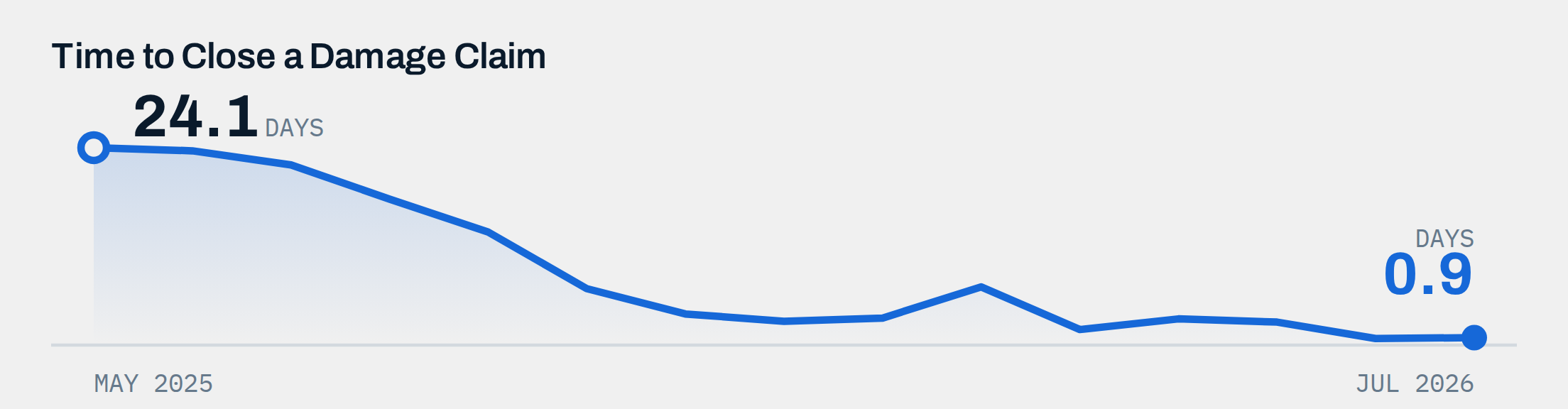
Median time to close a damage claim fell from 17.9 days to 2.2 days, an 88% reduction. The average fell from 32.1 days to 8.7.
That is not an adoption curve flattering the recent numbers. RocketFast closed 369 claims in their first six months and 457 in their most recent six. Volume went up while resolution time went down, which means the process got faster rather than the team finally starting to use the feature.
Fast became normal, not exceptional
Three out of four claims now close within a week. It used to be one in four.
Every location operates to the same standard
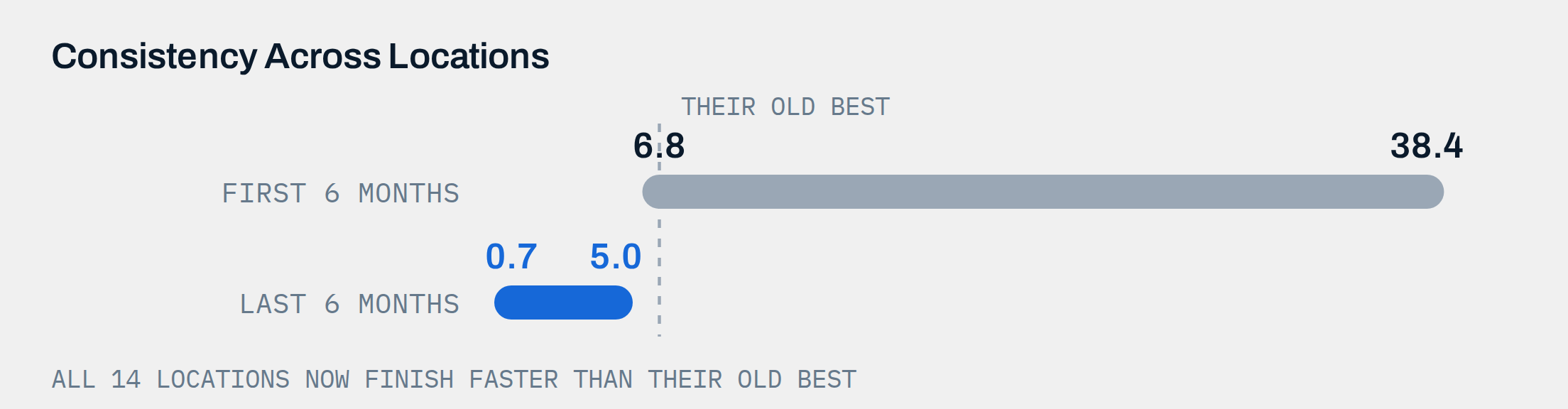
This is the one that speaks directly to what Mike said about consistency.
Read the slowest row twice. RocketFast's lowest-performing location today closes claims faster than their best-performing location did in year one.
"Now we can accurately see the flow of incidents."
Mike D., Head of Operations
Asked what the single biggest problem WashUp solved, Mike's answer was two words: incident management.
Across every statement on the survey, the one he marked at the top of the scale was that WashUp feels built for how car washes actually operate. That is the difference between a general-purpose ticketing tool and a claim form that already knows what a VIN is, what a bay is, and why a photo taken thirty seconds after the fact matters more than one taken the next morning.
"Do it! You won't find a better product backed by a better team."
Mike D., Head of Operations


